 EN
EN

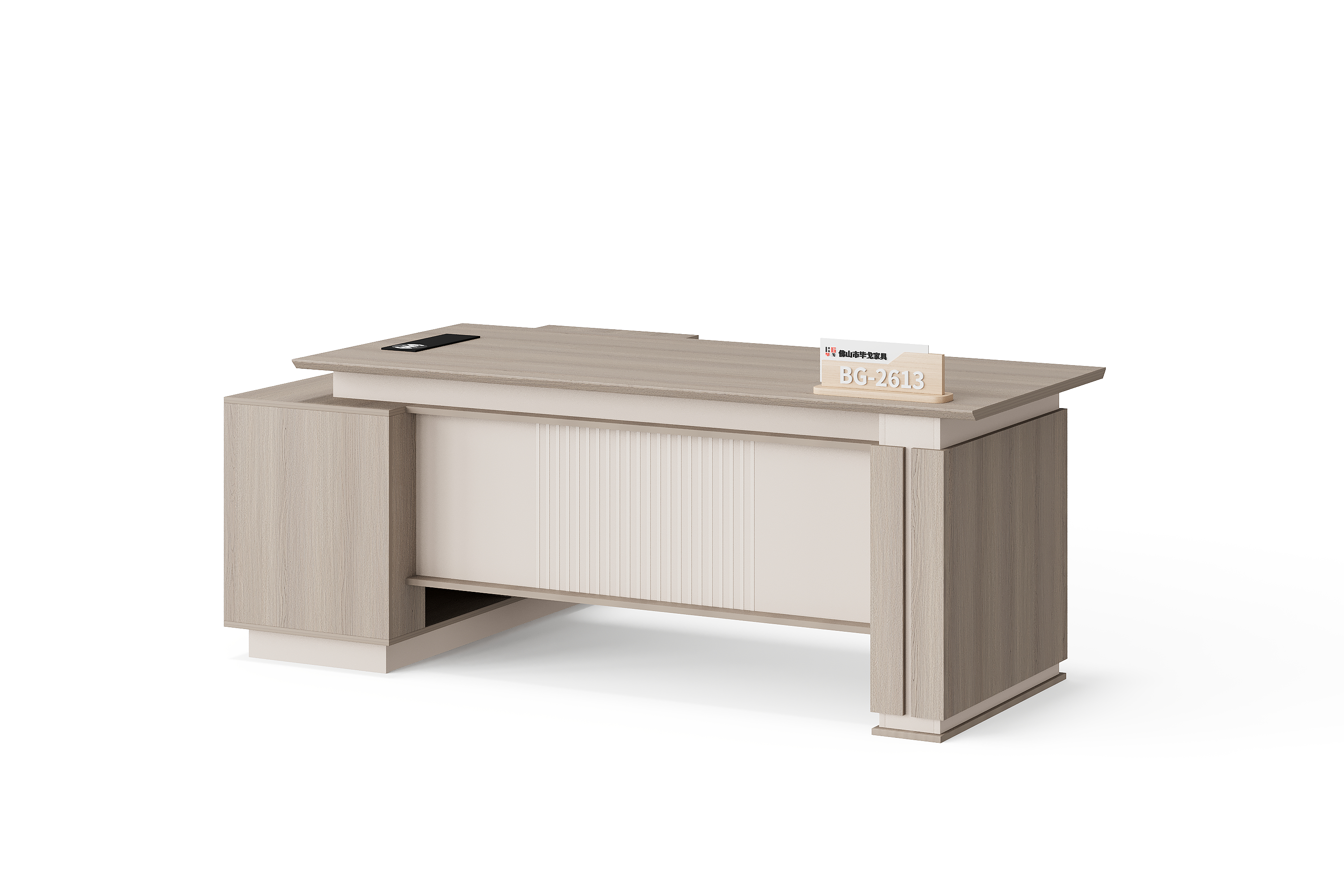
“Side cabinet on the left” is incomplete unless the buyer and supplier share the same viewpoint. Someone facing the desk from the visitor side sees the opposite left and right from someone sitting behind it. Before requesting a quotation, describe the orientation in words and mark it on the same reference image or plan.
This checklist helps buyers specify executive desks and adjoining storage. It is a way to communicate a requested arrangement, not confirmation that a particular BG model comes in both orientations or can be reversed during installation.
1. Define the viewpoint before saying left or right
Choose a viewpoint for your enquiry and write it down. For example: “All left and right references in this brief are from the seated desk user’s viewpoint, facing the main work surface.” This is a definition for your project, not a claim that every supplier uses the same naming convention.
On the plan, mark the desk user’s position and an arrow showing the direction they face. Label the visitor edge separately. Then identify the required side cabinet with an arrow and a short note. Ask the supplier to confirm its own configuration code against this marked drawing, rather than relying on the word “left” alone.
2. Keep the reference image in its original orientation
Start with a clear reference from the BG executive office furniture category. Save the page address and image filename with your enquiry so the reference can be traced. Use arrows and labels on a copy; retain the unchanged original beside it.
Do not flip a product photograph to represent another version. A mirrored picture illustrates a visual change but does not establish that the construction is available in that arrangement. Likewise, do not interpret letters in a filename or model reference as proof of left-hand or right-hand availability.
If the picture hides the cabinet’s working side, request another view or a drawing showing its doors, drawers and connection to the desk. Mark what needs confirmation rather than guessing from a front view.
3. Add a small orientation schedule to the room plan
Give each room and desk a reference. Show the room entrance, fixed obstacles and the desk user’s intended position. Record measured room information separately from supplier-confirmed furniture dimensions. The schedule below lists what to request; it does not prescribe a standard clearance or product size.
| Record | What the marked plan should show |
|---|---|
| Desk reference | Room, item reference and the original product image or page. |
| Viewpoint | User position, facing arrow and visitor edge. |
| Side storage | Requested side, cabinet access face and items to be included. |
| Room fit | Measured room features and overall arrangement dimensions awaiting confirmation. |
| Revision | Drawing date, revision reference and the supplier’s returned configuration code. |
Keep separate entries for rooms that need different arrangements, even when their desks look similar. Do not group them under a single “same as photo” instruction. Use a furniture quantity schedule to connect each configuration reference to its requested quantity.
4. Ask whether the configuration is fixed or changeable
Request written confirmation for the exact desk and storage combination. Ask whether the proposed orientation is supplied as a distinct version, can be changed during assembly, or is unavailable. Until the supplier answers for that model, treat reversibility as unknown.
Ask which parts attach to or support the desk and which are separate pieces. Confirm the cabinet access face, any requested cable route and the complete installed footprint. The room plan should also show where cabinet doors or drawers would open, so the proposed arrangement can be reviewed against surrounding furniture.
Storage placed beside a desk in a photograph is not automatically included in the quoted desk. Request an itemised inclusion list. Chairs, decorative objects and other scene props should not become order items by implication; chairs and sofas are outside the BG product scope covered here.
5. Confirm the drawing used for the quotation
A short enquiry note can say:
“For desk D01 in Room A, please quote side storage on the seated user’s left, as marked on drawing R1. Confirm the model, configuration code, included components and overall dimensions. Please return the marked drawing with any differences identified. Do not substitute the opposite orientation without our confirmation.”
D01, Room A and R1 are illustrative references, not a BG product configuration. If the arrangement changes, issue a revised drawing and identify the version it replaces. Ask for the quotation and component list to use the same revision. Attach this sheet to your broader office furniture RFQ checklist.
Buyer questions
Is a desk described as “left-hand” enough to place an order?
No. Define the viewpoint, attach the marked plan and obtain confirmation of the exact configuration. A short label should refer back to that agreed information, not replace it.
Can I move the side cabinet to the other side later?
Ask about the selected model before assuming this is possible. Its connections, supporting parts and access arrangement need confirmation. An image of an opposite-facing desk does not prove that the same unit is reversible.
Should the cabinet opening face the desk user?
Show how the intended user needs to access storage, then ask which configuration can provide that access. Mark the opening face on the plan and request a suitable view; do not assume a visible panel is a door.
What if several offices need opposite arrangements?
Create separate configuration references and quantities, with a marked drawing for each. Ask the supplier to identify how the confirmed versions will be distinguished in the quotation and packing information.
Send one clear orientation brief
Contact BG Office Furniture with your room plan, original reference image, marked orientation and quantity schedule. Ask for confirmation of the available configuration, dimensions, materials, inclusions and commercial terms before approving the order.
Table of Contents
- 1. Define the viewpoint before saying left or right
- 2. Keep the reference image in its original orientation
- 3. Add a small orientation schedule to the room plan
- 4. Ask whether the configuration is fixed or changeable
- 5. Confirm the drawing used for the quotation
- Buyer questions
- Send one clear orientation brief